3°54'48.90"S 29°50'21.60"E
 |
| (Wikimedia) |
Perched atop Mount Kikizi, the Burundian replicas of the Egyptian pyramids aren't really eye-catching or spectacular seen from afar, yet, their significance is enormous. Built in 1934 by the German explorer and ethnologist Burkhart Waldecker, the structures might mark the answer to a riddle that has been kept figures like Herodotus, Emperor Nero and David Livingstone busy for millennia: where exactly is the source of the Nile, Father of African Rivers and the lifeblood of many ancient civilizations? Depending on who you ask, the answer will vary, but all will agree that the pyramids in Mount Kikizi indicate the remotest and southernmost of all possible sources.
Before King Narmer unified Lower and Upper Egypt in the year 3150 BC, the Nile's wide riverbed served as the first border in recorded history. The Nile's waters would also provide fertile lands used for agricultural purposes, and they facilitated the transport of big limestone blocks via barges and rafts for the construction of the majestic Pyramids of Giza; thus creating a flourishing society along the riverbanks. The Egyptian nation was born and would last bound to the Nile to this day, where it continues to be the main economic and social pillar: 95% of the population lives along the Nile, and a quarter of the country's total exports depend on it. Additionally, the Egyptian government is financing a $15 billion initiative called "The New Delta", in which it is planning to transform a massive patch of desert into fertile land via an irrigation system connected to the Nile ---the crops the authorities have decided to plant include potatoes, strawberries and a variety of citrus fruits. On another occasion, when Ethiopia built the largest hydroelectric dam on the continent upstream, (Grand Ethiopian Renaissance Dam), Egyptians saw threatened their economy, and therefore entered into a regional geopolitical conflict.
 |
| The Grand Ethiopian Reinassance Dam, the largest on the continent (Wikimedia) |
Now, to uncover the origin of this power and wealth generator, we must trace back its course starting from the delta. Roughly the size of Slovenia, the Nile Delta is an intensively farmed region and metropolitan hub, including cities such as antique Alexandria and Port Said, located in the northern tip of the Suez Canal. After passing through Cairo, the Nile carves its way through iconic lost cities and mythical monuments such as Giza, Memphis, Karnak, Luxor, the Valley of the Kings or Abu Simbel; only to slow down before reaching- the Aswan High Dam, a gateway that leads the river to Lake Nasser where it eventually crosses the Sudanese border. But once the stream has reached Khartoum, Sudan's capital, it splits into the two main tributaries that form the Nile at a place known as Al-Mogran (Arabic for "The Confluence"); said tributaries are the Blue Nile and the White Nile. On the one hand, the Blue Nile is the most voluminous one of the two, but is shorter in distance ---its source is located in Lake Tana, in the Ethiopian Highlands, approximately 1,400 kilometers (900 miles) away from Khartoum. On the other hand, the longer but less voluminous White Nile has sparked a centuries-old quest to pinpoint its source, which has captivated thinkers and explorers from all over the world.
 |
| Clockwise from left to right: the Nile river delta seen from space; Abu Simbel; hippos at Lake Tana; and Khartoum's sunset. (Wikimedia: 1, 2, 3, 4) |
Owing its name to the clay sediments that dye its waters a whitish-gray tone, the White Nile flows slowly through its linear course that cuts right through the Nubian desert before reaching South Sudan's Sudd wetland, which has historically always been the natural border that separated the advanced Egyptian society from the southern tribes. In the present, it hosts the unfinished structure of the Jonglei Canal, a government-backed initiative to support the rapid flow of the Nile's waters, but which has halted due to the Sudanese Civil War and the secession of the southern part of the country. It is only useful for those who want to seek shelter from the massacres and benefit from freshwater: more than 50,000 victims have sought refuge in the town of Chuil and neighboring villages.
Thereupon, the White Nile reaches Uganda's rainforest, where it merges with the Albert Nile and where it later branches off into the Victoria Nile. The latter originates in the Lake Albert, passes through Lake Kyoga and finally originates in Lake Victoria, Africa's largest ---and the world's third largest--- reservoir. While some consider this the final stage of the Nile system's course, others attribute it even further south as Lake Victoria is in turn fed by the Kagera River. Lastly, this stream's source is also disputed as there are many possible headwaters coming from both Rwanda and Burundi. Here is a map to summarize it graphically:
 |
| One map is more valuable than one thousand words (Unadapted file from Wikimedia) |
As early as the Antiquity it caught the attention of Greek and Roman thinkers. Specifically, it all started with Herodotus' questions. While travelling in Egypt, he witnessed the flourishing cities the Nile helped shape, famously nicknaming Egypt "the gift of the Nile" in his chronicle The Histories; but he also witnessed the Nile's devastating annual floods. And this made him think: how could there be such a long stream of freshwater cutting right through the Sahara's dry sand dunes? How could the Nile flood annually? After asking local intellectuals who gave him no answer and briefly studying unconvincing suggestions from other philosophers, he decided that the only way to find out was by searching for the source himself. Unfortunately, he didn't get past Aswan, yet it is outstandingly impressive that a man who lived in the 5th century BC tried to search for a place we still haven't completely identified in the present day.
 |
| Statue of Herodotus in Vienna (Wikimedia) |
After Herodotus' brief trip, the Romans followed. During the 1st century BC, many expeditions were made across Africa to uncover possible riches and learn about new nations, fauna and flora. The Romans became the first European civilization to penetrate deep into the sub-Saharian regions, recording Lake Chad and the Niger River. But during Nero's reign, the challenge would be bigger: to find the source of the Nile. Thus, he sent a group of legionaries who departed from Meroe, in present-day Sudan, and whose experiences would later be transcribed by Seneca. Sailing on small boats and rafts, the Praetorian guard explored the immense Nubian Desert and survived the deadly illnesses and crocodiles in the Sudd wetland; but afterwards, there is no clear record of what happened before turning around. Some say they simply couldn't advance any farther in the swampy region, while other historians agree that they reached as far as Uganda's steep Murchison Falls, as Seneca later quoted: "We saw two rocks, from which the force of the river flowed out with power".
 |
| Murchison Falls (Wikimedia) |
With the rise of modern European colonialism, the ambition to map and discover unknown regions rose as well. Prominent voyages include the one made by Spanish Jesuit missionary Pedro Páez, who in the 17th century found the source of the Blue Nile at Ethiopia's Lake Tana. But it truly became interesting in the 19th century "Scramble for Africa", when the famed Scottish doctor and missionary David Livingstone set up three expeditions that would go down in history. He first worked as a medical missionary in South Africa and made various trips to Bechuanaland (present-day Botswana) to spread Christianity and trade with the locals as an alternative to the slave trade, an activity he heavily opposed and criticized in his diaries. Next, his life took a big turn when he discovered the Zambezi River, a major stream whose course opens a gateway to Africa's interior and the west coast.
 |
| Pedro Páez, discoverer of the Blue Nile's source (Wikimedia) |
Accompanied by a local Makololo guide, he pioneered in the development of an ivory and wax trade route from the port of Luanda, Angola, to the port of Quelimane, Mozambique. On the journey, he also came across a massive waterfall system called Mosi-oa-Tunya (Setswana for "the smoke that thunders"), which he renamed to Victoria Falls in honor of the British queen. He returned to the UK, only to come back to Africa two years later after mapping his trip and recording it in a book. In the second voyage, he was backed by the British government to set up a commercial route in the Zambezi basin and to record natural resources. However, the mission failed after many expedition members died of severe illnesses, including his wife Mary. Now, while Livingstone was back in Great Britain, another famed explorer was mapping the African lake region and allegedly discovered the Nile's source. He was John Hanning Speke, a man who left Zanzibar in 1857, and who one year later became the first European to discover Lake Tanganyika and Lake Victoria. In the latter one he encountered Uganda's Rippon Falls, the location he and the British Crown identified as the source of the Nile. But Livingstone thought otherwise.
 |
| Livingstone's first expedition along the Zambezi (Wikimedia) |
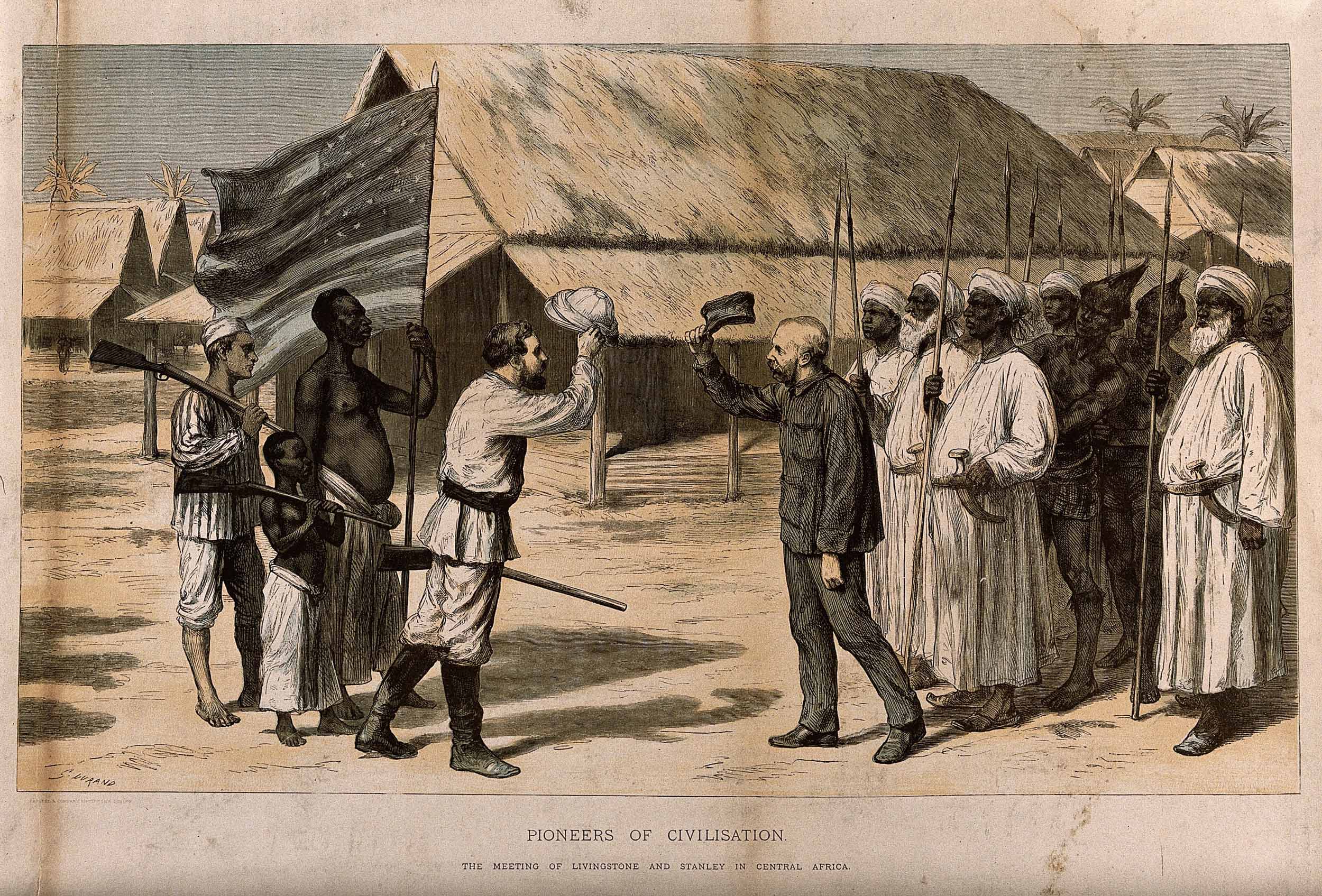
Therefore, he left the UK once again and went on expedition through the Lualaba River to prove Speke wrong. Reached the lake region, he recovered an old Egyptian theory recorded in Herodotus' The Histories that claimed there were "four fountains" (headwaters) that fed the Nile; according to Livingstone's analysis, these rivers were the Lualaba, the Lomani, the Zambezi and the Kaufe. After spending several months in the region mapping it, Livingstone witnessed a human massacre in a little village called Nyangwe, in which Arab slavers executed over 400 slaves. Traumatized, Livingstone decided to return to the town of Ujiji on the shores of Lake Tanganyika, where he would be greeted by Henry Morton Stanley with the famous phrase "Doctor Livingstone, I presume?". But on the brink of madness and profound psychological problems, 60-year old Livingstone decided to go back to the rainforest one last time to ultimately see the Nile's source and prove his "four fountains" theory. The severe illnesses and pains killed him in 1873 in Bangweulu, Rhodesia (Zambia), without succeeding in challenging Speke's assumption. Later, Stanley tried to verify out Livingstone's point, but failed in the attempt, crediting Speke with the ultimate find.
 |
| "Dr. Livingstone, I presume?": Livingstone on the left, Stanley on the right (Livingstone Online) |
Yet, Speke's claim would once again be denied. This time, it was the German-Polish anthropologist Dr. Richard Kandt, future governor of German-ruled Rwanda, who financed a trip himself to seek an even further source of the Nile. After days of research in the Rwandan highlands, he asserted in 1898 that the ultimate headwaters belonged to the source of the Rukarara-Nyabarongo system. Thirty-six years later, a new theory was developed by Burkhart Waldecker, a Jewish Belgo-German ethnologist who sought asylum from the Nazi persecution in Africa, with one clear goal, to trace back the Nile and the Kagera's most remote source. After four years, he ultimately uncovered Gasumo Spring, a little fount in Mount Kikizi near the town of Rutovu from which the isolated Ruvyironza River originates. Waldecker decided to build a commemorative pyramid resembling those of Giza, containing an inscription with his name and the Latin phrase Caput Nili Meridianissimum: "The Southernmost Head of the Nile".
Further reading:
Sources and Picture Credits:
Sources: Beyond Africa Safaris, Atlas Obscura, BBC, Livingstone Online (1) and (2), First Philosophers, Romano Impero, The Paris Review, Reuters, NASA Science, Relief Web, RTVE
Picture 1: https://www.flickr.com/people/23442653@N00 (Dave Proffer)
Picture 3.4: https://www.flickr.com/photos/99216220@N08/ (Waddah Seifeldin)
Picture 3.2: https://www.wikidata.org/wiki/Q28147777 (Diego Delso)
Picture 6: https://commons.wikimedia.org/wiki/User:Jedesto
Picture 9: Wellcome Library, London
Picture 3.3: https://commons.wikimedia.org/wiki/User:A.Savin
Picture 4: Wikimedia user Imagico (Note: this image has been rotated, cropped and has received text content)


No comments:
Post a Comment